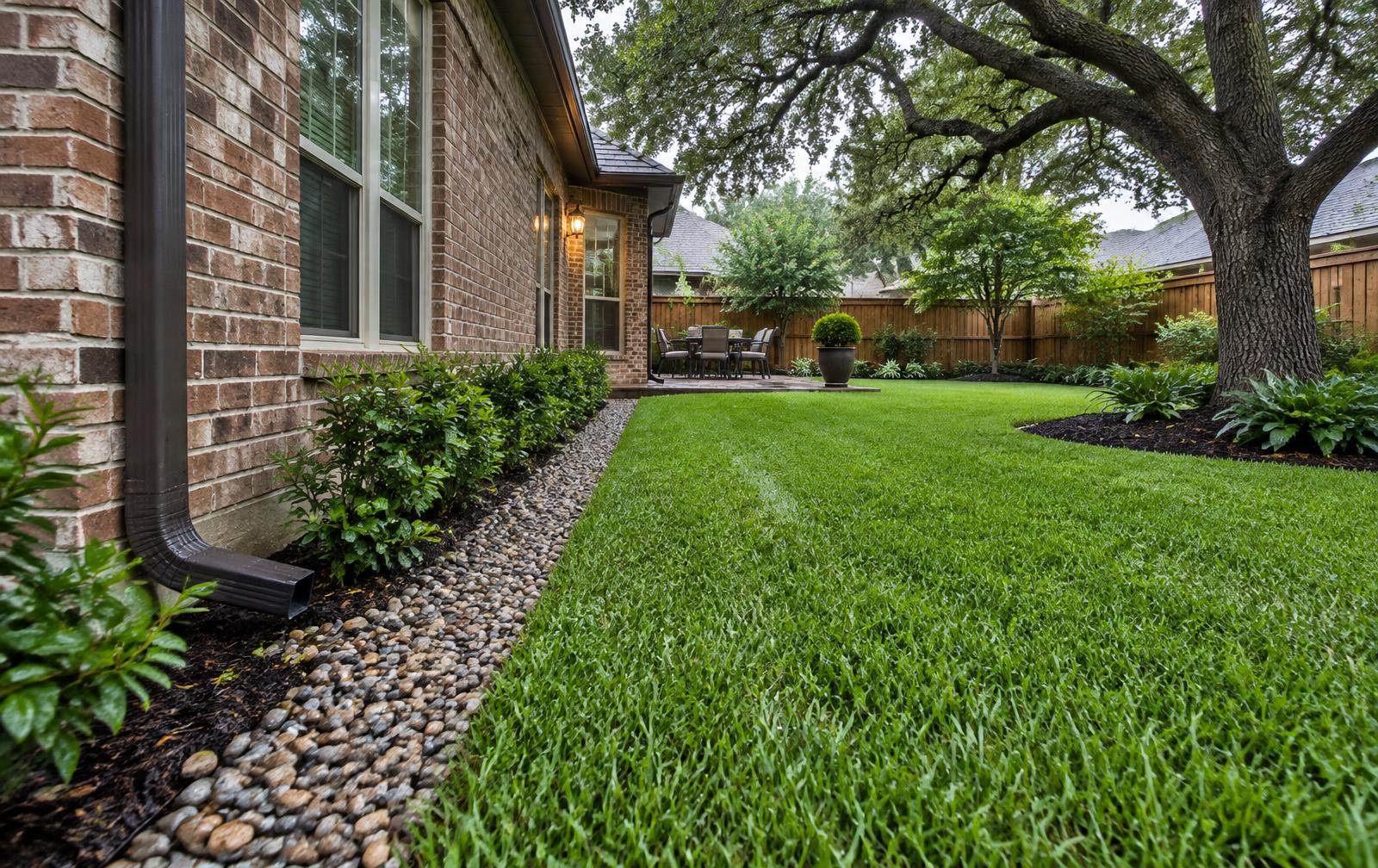
Houston yards
should drain.
French drains, catch basins, and buried downspouts planned around the water path—not a one-size-fits-all trench.
Drainage systems
Fix the source. Move the water. Restore the yard.
Each component has one job. The right plan combines only what your property needs.
French drains
Intercept subsurface water and carry it to a deliberate outlet—not another low spot in the yard.
Explore serviceCatch basins
Capture fast-moving surface water at low points before it spreads across turf, patios, and walkways.
Explore serviceBuried downspouts
Move concentrated roof water away from the slab through a closed, buried drainage line.
Explore serviceFoundation drainage
Manage abrupt moisture differences around the slab in Houston’s slow-draining, expansive clay soils.
Explore serviceWhy Houston stays wet
“Gumbo” clay holds water—and changes when moisture changes.
The Beaumont Formation beneath much of Houston contains low-permeability clay and silt. Water infiltrates slowly, while expansive clay can shrink and swell as moisture changes.
The goal is controlled movement, not simply burying water.
A complete system collects runoff and conveys it to a workable outlet. Drainage can reduce ponding, but it is not a foundation repair or structural guarantee.
Low permeability
Fine clay accepts stormwater slowly, so shallow low spots can stay saturated.
Moisture variation
Abrupt wet-to-dry differences around a slab can contribute to soil movement.
Intense rainfall
Roof and surface runoff can overwhelm a flat lot in a short storm.
An outlet matters
A drain needs somewhere suitable to discharge, by gravity or a designed pump.
Built from the soil up
A drain that keeps flowing
Fabric separates fine clay from the drainage stone. Open-graded rock creates storage space, while the sloped perforated pipe carries collected water to a defined outlet.
No shortcuts underground
Every layer protects the flow path.
Houston’s fine clay can migrate into open stone. Proper separation fabric helps keep soil out while allowing water through. Washed gravel creates void space; a correctly sloped perforated pipe carries the collected water onward.
- Non-woven geotextile separates clay from stone
- Washed, open-graded gravel creates drainage space
- Perforated pipe collects; solid pipe conveys
- Accessible cleanouts support future maintenance
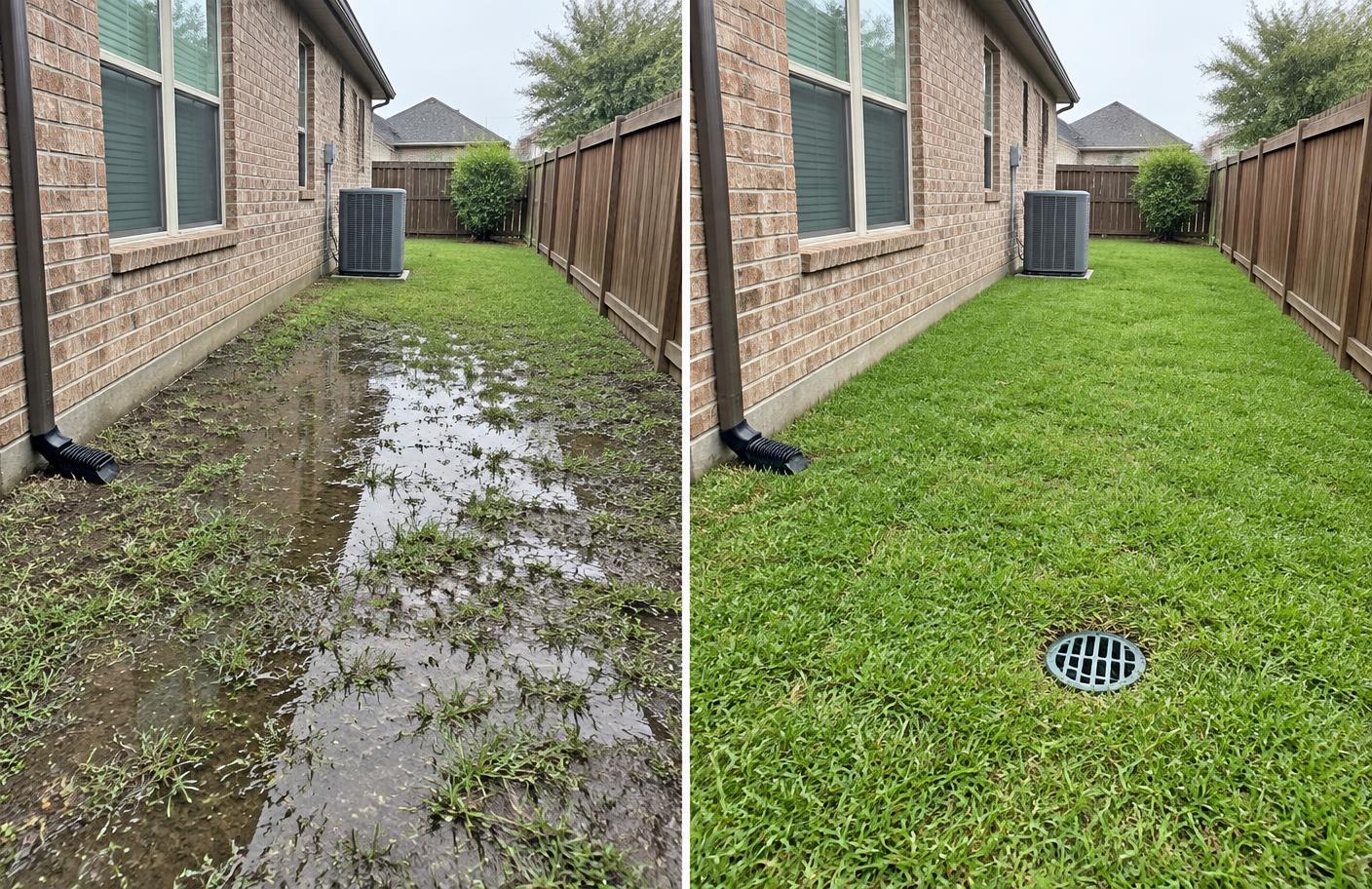
Representative case study
A side yard that no longer acts like a shallow pond.
The visible symptom was standing water. The planning question was bigger: where was runoff entering, and where could it go? A catch point plus closed conveyance can capture surface water while keeping the restored lawn usable.
Observed
Saturated side yard
Approach
Collect + convey
Illustrative project example; scope and results vary by property.
Plan before the site visit
Get a realistic starting range in about two minutes.
Tell us what you see, the approximate distance, and which components may be involved. We’ll calculate a planning range and list the site conditions that could change it.
Instant planning range
Yard drainage cost estimator
Service area
Local drainage planning across Greater Houston.
Katy
Drainage for master-planned lots, flat grades, and closely spaced side yards.
View local servicesCypress
Drainage for fast-growing neighborhoods, broad lawns, and varied lot elevations.
View local servicesThe Woodlands
Drainage for mature tree cover, shaded turf, and carefully preserved landscapes.
View local servicesConroe
Drainage for sloped lake-area lots, rolling terrain, and fast runoff toward low ground.
View local servicesMagnolia
Drainage for large wooded lots, long drainage runs, and heavy gumbo clay soils.
View local servicesHumble
Drainage for flat clay lots and older subdivisions with aging yard-drain systems.
View local servicesSpring
Drainage for wooded properties, mixed elevations, and high roof-runoff volumes.
View local servicesA drier yard starts here
Ready to get water moving?
Start with a no-pressure drainage inspection and a plan built around your property’s actual grade and outlet.